TELESCOPE REVIEWS
Telescope Advice
Orion Reviews
Celestron Reviews
Intelliscope Reviews
FUN SCIENCE
Astronomy 101
Astronomical Tales
ET Planet Finder Kit
Space Station Live Video
Space Station Sightings
2017 Total Solar Eclipse
Animated Solar System
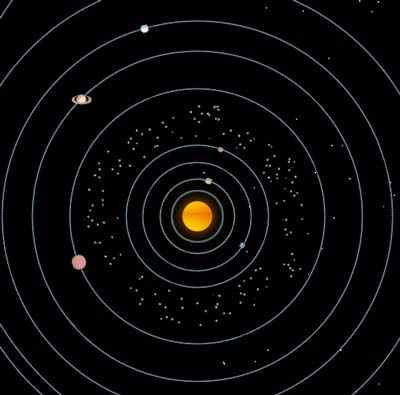 See an animation of the movement of planets in our solar system.
STARS & GALAXIES
Tonight's Sky
Name a Galaxy
Galaxy Registry Archive
 See amazing views from space
THE PLANETS
Planet Pluto
Animated Solar System
Extraterrestrial Worlds
In Search of ET
Mars: Facinating Facts
WINDOWPANE OBSERVATORY
Deep Space Bulletin
About the Observatory
Credits
Contact WPO
Looking for comets, supernovas, and Earth-bound asteroids.
Orion Intelliscope Review
The Orion Intelliscope System
The Orion Intelliscope system is a commercial version of digital setting circles that became all the rage for folks who like to own or build large telescopes but really don't know their way around the sky.
To understand how the Intelliscope works, it would be good for the uninitiated to understand how objects were found in the sky for amateurs and students of astronomy before this digital technology.
The sky is divided into latitude and longitude, called by astronomers Right Ascension and Declination. This is our terrestrial navigation system projected onto the celestial sphere that is what our universe appears to us from Earth.
Every object has been plotted on this celestial map and every object, no matter how faint, has a specific location in the sky down to degrees, minutes and seconds. Until about 100 years ago all telescopes, even the ones in the great observatories like Lick and Yerkes, the largest reflectors and refractors of their day, had huge setting circle wheels that were aligned with the Earth's axis.
This allowed a clock drive to turn the telescope with the motion of the Earth so that the celestial object remained in the eyepiece. More importantly it provided at vernier by which a large dial represented the position of an object. Let's say you want to find the Andromeda Galaxy. Simply find the RA and Dec. coordinates for Andromeda and then add or subtract the time for universal time to align your telescope which the current position of the earth in space and voila! you found your object.
In real life, you nearly found your object, since only large setting circles prove to be really accurate.
Digital setting circles like the Intelliscope work a little differently. In the old days if you owned one of the major brand telescope like a Meade or a Celestron, you had to align the axis of the telescope with axis of the Earth. That is, you had to point the telescope mount and align it with the true north which was near the North Star Polaris. Depending on how accurate that alignment was would determine the accuracy of your setting circles which you had look at with a red flashlight in the dark to read.
So if your telescope was not in some kind of permanent observatory, you had to drag the tripod and mount out into your observing space, polar align the telescope, and then fumble around in the dark looking up coordinates of your object with a red flashlight so you don’t lose your dark adaptation and then use that same red flashlight to read tiny numbers on the manual setting circles hoping that your polar alignment was good enough to put the object in the finder scope.
The Intelliscope solves those "Macho Astronomy" problems by it hefty microprocessor that actually self-corrects based on the real time position of 2 bright 1st magnitude "Guide Stars". Since 1st magnitude stars can be found even in big city backyards, the method is fool proof. Once the on-board computer has confirmed the real-time positions of the 2 reference objects, any object in the Intelliscope's 4,000 object memory becomes available. Simply move the telescope in the direction the computer read-out tells you. As you manually slew the telescope the computer tells when you are getting closer or farther. It takes a little getting used to, but it’s actually quite easy and intuitive.
Consider This...
There are 2 things to consider with a celestial object catalog of this magnitude (if you’ll pardon the pun)
1. Many of the objects stored on the Intelliscope are too faint to be seen unless you have very big optics or a very dark site or a combination of both.
2. It takes a long time to see 14,000 objects. A typical observing session will usually never exceed 10 objects, as fatigue, eye strain, and colder nighttime temperatures start to take their toll. At 10 objects per night with roughly 7 clear moonless nights/month, it would take 2,000 months or 166 years to see all the objects in your telescope’s targeting computer!
So, in closing, the Intellcope will never leave you panting for anything more except a larger light bucket to collect more of those ancient rays and direct them into your eagerly awaiting retina. But "aperture fever" will have to wait for another article.